

Data Center Air Pollution & Local Health Impacts
By Richard Klein
KEY DATA CENTER ZONING ORDINANCE COMPONENTS To Gain Data Center Benefits Without Harming Area Residents Community & Environmental Defense Services, submitted to the Coalition for Responsible Data Center Development.
March 10, 2026
KEY DATA CENTER ZONING ORDINANCE COMPONENTS
To Gain Data Center Benefits Without Harming Area Residents
CEDS has found the most effective data center strategy is to urge local elected officials to institute a moratorium while putting in place zoning ordinance amendments safeguarding residents from noise, excessive water consumption, air pollution, and other impacts while ensuring economic benefits are maximized. The following measures are drawn from data center zoning ordinances adopted by local jurisdictions (towns, cities, counties) across the U.S. For further detail on the issues presented below see the CEDS webpage How to Protect Your Home from Data Center Impacts at: https://ceds.org/datacenter/.
Likelihood Of Data Center Adverse Effects
How likely is it that a proposed data center will harm those living nearby? Following are two sources indicating 10% to 18% of those living near a data center may experience adverse effects.
Virginia has more data centers than any other state. In December 2024, the Virginia legislature released the report Data Centers in Virginia. This 156-page report contained considerable information regarding the pros and cons of data centers as well as recommendations for gaining more of the benefits with fewer adverse effects to those living far and near. The report noted that 10% of data centers “appear to have generated noise that nearby residents regard as problematic, according to resident groups and government records.”
In 2025, CEDS conducted a survey of those living near 33 data centers in 25 states. The survey consisted of a letter mailed to 236 households located 20- to 1300-feet from existing data center buildings. Recipients were asked to complete a brief online questionnaire about benefits or negative effects they experienced due to a data center. Those living near six (18%) of the 33 data centers reported adverse effects while one reported that a nearby data center was beneficial because of free internet access.
From using online mapping tools to generate the survey mailing list, we found the vast majority of the 4,000+ data centers in the 50 states are far from homes and mostly in industrial areas. However, as available industrial area sites diminish, future data center locations may move ever closer to homes. Research presented in this letter indicates that data center noise and air pollution may adversely affect those living up to a mile away and even further in some cases.
Require Lowest Impact Data Center Designs To Meet Stringent Safeguards
It is extremely important that data center designs incorporate THE most effective and reliable measures for preventing impacts. It is equally important to put in place regulations to safeguard area residents if measures fail.
Data centers will likely become essential to the local economy. It would be unwise to depend on enforcement alone to safeguard area residents. There are simply too many examples ofenvironmental and quality of life protection laws where noncompliance is both significant and
persistently high. Once established, a data center may become a very powerful and influential corporate entity. Elected officials may find it difficult to force a data center owner-operator to resolve impacts, especially in small, rural communities.
Restrict To Industrially Zoned Sites
Data centers are an industrial use. If a data center meets all the criteria presented in this document, then it might be considered a Light Industrialuse since adverse effects would not extend beyond the site boundary. Otherwise, data centers should be restricted to heavy industrial (aka manufacturing, general industrial) zoning districts.
Require Conditional Use Permit
Because data centers are a relatively new land use where impacts can vary considerably from location to location and year to year, Conditional Use approval should be required where:
There is ample public notice in the form of letters sent by the local government – not applicants - to all property owners within 500 feet and signs are posted along roads adjoining the site,
Public hearings are held by a planning board and then the local elected legislative body (town or city council, county commissioners or supervisors, etc.),
Required findings address impacts to public health, safety, and welfare such as noise, air quality, visual impacts, loss of property value, water supplies, aquatic resource health, etc., and
Additional safeguards can be required when warranted by site- or use-specific impacts.
In some jurisdictions a Conditional Use permit may be known as a Special Exception or Special Use permit. For further detail see the CEDS Condition Use-Special Exception webpage at: https://ceds.org/se/.
Noise
Data center noise can disturb those living up to a mile away. The noise can come from the following data center components:
Air handling units,
Air-cooled chillers,
Backup diesel generators.
Cooling towers, and
Indoor servers though this is more an issue for those working inside a data center.
Data centers are one of the very few uses, besides power plants and gas compression stations, that generate low-frequency noise. This noise has proven to be very disturbing to those living near some – but not all – data centers. To appreciate the penetrating nature of low-frequency data center noise, think of a car with deep bass music blasting from inside and how that noise is heard outside the car even at a considerable distance. If the car passes near a home, it even passes through windows and walls.
To get a sense of the impact and science of data center low-frequency noise see the four-minute news clip at: https://www.youtube.com/watch?v=JflFFqbZ1X8. The clip focuses on a data center located in Prince William County, Virginia which has more data centers then most U.S. counties.
Data center low-frequency noise has been described as a hum. At first you wouldn’t think a hum would be particularly disturbing. The hum becomes a constant nuisance which has made life quite miserable for those living near some, but again, not all data centers. Once the hum is noticed the mind cannot ignore it and, as noise expert David Nelson said, our minds never get a chance to rest.
The noise described in the news clip above was particularly disturbing to those living within 1300 feet of a data center. The study at the following link indicates data center noise may be an issue up to 0.75-miles away: https://app.box.com/s/0mefhonpq91bzq2e77l1q9mxrrc6iyb1. The point where data center noise impacts become unlikely may be one-mile distant.
It appears that low-frequency noise is most likely if a data center is air-cooled while a liquid (water) cooled system is relatively quiet. A closed-cycle water cooled system should be used to prevent excessive water consumption and possible aquatic resource impacts due to cooling water discharges. Regardless of the cooling system, a county or city should adopt a data center noise ordinance before granting any approvals or taking other actions that may exempt a proposed data center from noise safeguards.
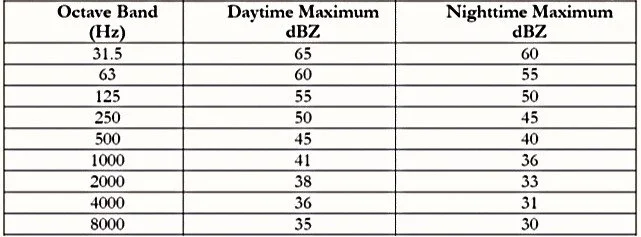
In addition to the usual A-weighted decibel (dBA) limits the ordinance must establish C-weighted decibel and octave band limits too. Low-frequency data center noise falls below the reliable detection limits of A-weighted decibels, hence the need for octave band and C-weighted limits.
A very informative memo documenting the technical need for the octave band and C-weighted data center standards is available at: https://app.box.com/s/jgwnmbza74d07cga6tyv07f4x2qryq7e. The memo was written by acoustic engineer David Nelson. The octave band levels in Table 1, on the next page, are the same as shown in Tables 4 and 5 of Mr. Nelson’s memo.
On March 18, 2025, Mr. Nelson provided the Prince William County, Virginia Supervisors with an explanation of why the octave band as well as dBA and dBC limits were essential to preventing excessive data center noise. The presentation begins at: 4:18:00 (4 hours:18 minutes) in the video posted at: https://pwcgov.granicus.com/player/clip/3614?view_id=23&redirect=true.
A-Weighted Decibels (dBA): Following are the A-weighted (dBA) maximum permissible residential sound levels (Leq) recommended by Mr. Nelson:
· Daytime dBA 60, and
· Nighttime dBA 55
C-Weighted Decibels (dBC): Limits on C-weighted decibels are also needed to resolve data center low-frequency noise impacts. Here are the recommended dBC limits in residential zoning districts again from Mr. Nelson’s memo:
No source of steady tonal sound may exceed the limits outlined below when measured at any location at or within a residential property boundary in a residential zoning district.
Maximum permissible C-weighted sound level at the receiving property:
Daytime 73 dBC;
Nighttime 68 dBC.
The limits above may not be exceeded over a five-minute interval.
Octave Bands: Table 1, below, presents Octave Band limits recommended by Mr. Nelson in his memo.
Table 1: Recommended Octave Band Sound Pressure Levels for Residential Zoning District
(As recommended by the resident members of the PWC Data Center Ordinance Advisory Group)
Again, all three noise limits, octave band, C- and A-weighted, are essential for ensuring data center noise does not harm area residents. A draft of the Prince William County noise ordinance which included all three limits recommended by Mr. Nelson and could serve as a model for other local ordinances, is posted at: https://app.box.com/s/6q66p2n1rtj3xs85ruv7408b06xvdnf2.
Backup Generator Noise:
While it is often claimed that diesel generators will seldom operate longer than brief testing periods, there have and will continue to be instances where noisy generators run for longer periods. For example, during a June 2025 heat wave in Loudoun County, Virginia, data centers were ordered to run backup diesel generators for several days due to concerns about insufficient power provided by the transmission line grid.
Whether diesel or propane, backup generators should be located within full acoustic enclosures. Proof must be provided prior to approval that the enclosures and any other measures will reduce noise levels to the limits presented above. Generators complying with Tier-4 USEPA emission standards are quieter by half compared to the Tier-2 generators common to data centers. As an additional noise safeguard, whenever possible data center buildings should be used to block backup generators and other noise-producing equipment by locating each on the far side of buildings from homes, schools, hospitals, etc. Routine testing of backup generators should be infrequent, of short duration, and limited to weekdays at a time when area residents are not sleeping and nearby school classes are not in session.
Noise Enforcement:
In addition to adopting a noise ordinance with the octave band and the C-and A-weighted limits above, the enforcing jurisdiction must provide the training and equipment compliance staff need to enforce these more complicated noise restrictions. However, should a data center exceed noise limits then a conflict of interest may inhibit corrective action. What if a town or county has become heavily dependent on data center economic benefits and data center owners-operators refuse to correct noise limit violations? The relatively small fines for exceeding noise limits may have little effect on the behavior of extremely wealthy corporations. This is another reason why jurisdictions should require data centers to use the most effective and reliable designs to protect area residents rather than relying heavily on enforcement. In the case of data center noise, a quiet, lower-impact cooling system like closed-cycle water would be more effective and reliable than air-cooling systems along with Tier-4 generators within full acoustic enclosures.
Water Use & Discharge
A large data center with an open-cycle liquid (water) cooling system may use and discharge 5 million gallons of water per day. This is equivalent to the daily water consumption of 17,000 households. A closed-loop or closed-cycle system can reduce water use by 70%. The chemicals listed to the right, from the Minnesota Clean Water Action fact sheet Data Centers — A threat to Minnesota’s growth may be added to data center cooling water rendering it unfit for human consumption or agricultural use. If discharged to streams, lakes, aquifers, or other waters the chemicals and cooling water heat could be very harmful to aquatic life. Instead, cooling waters should be released to the soil surface or subsurface in compliance with local, state, and federal onsite or land application wastewater disposal regulations.

In a 2024 article, Sustainable by design: Next-generation datacenters consume zero water for cooling, the following was announced:
“Beginning in August 2024, Microsoft launched a new datacenter design that optimizes AI workloads and consumes zero water for cooling. By adopting chip-level cooling solutions, we can deliver precise temperature control without water evaporation.
The zoning ordinance or other regulations must require that data centers demonstrate that they will incorporate this or other, equally effective and reliable state-of-the-art technology for minimizing water use. Additionally, data center applicants must be required to demonstrate that the volume of water consumed will not impact other users or receiving waters. Some jurisdictions require that if a data center is proposed near sewerlines or a sewage treatment plant that treated wastewater be used for cooling.
Air Quality & Public Health
Most data centers rely on numerous backup diesel generators to provide electricity in the event of transmission grid power outages. The carbon monoxide, particulates, sulfur dioxide, nitrous oxides, and other pollutants emitted from data center diesel generators can pose a significant regional and local public health risk. The research presented below indicates a single, data center may adversely affect the health of those living at least 0.6-miles away and possibly miles further under some circumstances. The impact zone of multiple data centers when clustered together, such as at a data center campus, may affect those living even more distant. The research also indicates it is difficult to predict where and when a data center impact zone will expand to affect an even larger number of area residents. This is why all proposed data center designs should be based on something like the
Washington state health impact assessment protocol with realistic worse-case assumptions. The data center should only be approved when it is proven that limits on hours of operation, generator emissions controls, alternate power supplies, and other measures will safeguard those living near and far from a proposed data center.
Local Health Impacts:
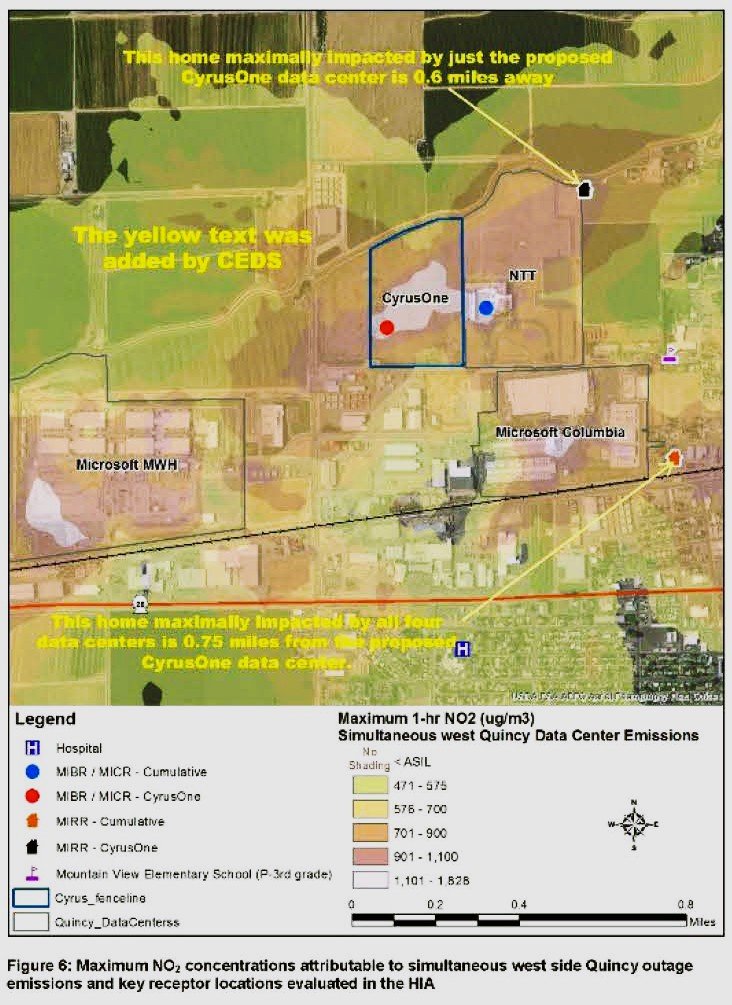
Some states, such as Washington, require a Health Impact Assessment (HIA) for the immediate vicinity of a proposed data center while many other states only assess health effects at the regional level. Figure 6 to the right is from an example of a local HIA, which was for the CyrusOne data center proposed for Quincy, Washington.
Note that in Figure 6, the furthest home impacted by just the proposed CyrusOne data center was 0.6-miles away. Figure 6 also shows three other data centers nearby. The maximally affected home due to the cumulative effects of all four data centers was 0.75-miles from the Cyrus One site.
Other Washington state HIAs have shown that a potential exists for relatively high short-term nitrogen dioxide (NO2) impacts miles downwind (due to terrain and conversion rate of NO in plume to NO2). That said, these high impacts likely only occur during outage scenarios when multiple engines (diesel generators) operate at the same time as happened in Loudoun County, VA in July 2025. Furthermore, the meteorology that produces these high concentrations (somewhat infrequent) combined with the likelihood of an outage (very infrequent for reliable power systems) leads to a low probability occurrence. Therefore, areas near the facilities (within a few hundred meters) are more likely to experience higher short-term NO2 levels compared to those areas farther downwind.
Regional Air Quality Impacts: In a 2025 paper, The Unpaid Toll: Quantifying and Addressing the PublicHealth Impact of Data Centers, researchers estimated that:
"Assuming that the actual emissions are 10% of the permitted level as a reference case that reflects both the historical reports and future demand response projections, the [data center] backup generators could already cause 14,000 asthma symptom cases and 13-19 deaths each year among other health implications, resulting in a total annual public health burden of$220-300 million throughout the U.S."
“Moreover, even short-term (hours to days) PM2.5 [2.5-micron particulate matter] exposure is harmful and deadly, accounting for approximately 1 million premature deaths per year from 2000 to 2019 and representing 2% of total global deaths.”
Further insights into the regional implications of data center diesel generator air pollution were provided in the 2026 paper Localized Air Pollution Impacts from Data Centers in Northern Virginia. Northern Virginia has more data centers than any other place in the world. In this 2026 study, researchers reviewed emissions data for 138 data centers with Virginia Department of Environmental Quality (DEQ) air discharge permits. As of 2022-2023, data center emissions accounted for a small percentage of carbon monoxide (CO), nitrous oxide (NOx), and 2.5-micron particulate matter (PM2.5) released to the atmosphere from all Northern Virginia sources. However, on average data centers were emitting just 3% to 5% of the pollution allowed by DEQ air discharge permits. Some data centers though were emitting far more than the average:
“…we find that 14 out of 104 facilities emitted 20% or more of their allotted totals in 2023, for at least one of the three pollutants. In some cases, the data centers emitted more than 40% of their total permitted emissions for a given pollutant.
Among the key findings were:
“If Northern Virginia data centers were to emit their total allowed pollution, per their DEQ permits, this would significantly increase the region’s total point source air pollution, for all pollutants other than SO2 (sulfur dioxide). Point-source emissions would increase by about 90% for CO and VOC (volatile organic compounds), 145% for VOC, and 235% for NOx. Total emissions (including mobile, etc.) would only increase by less than 5% for most pollutants but would increase 45% for NOx.”
The researchers compared data center emissions with other major sources in Northern Virginia such as landfills, waste incinerators, and power plants. The comparison revealed:
“Permitted data center emissions would be orders of magnitude higher than those from these other facilities, particularly for CO, NOx, and VOC.” [if all were emitting the maximum allowed by DEQ discharge permits]
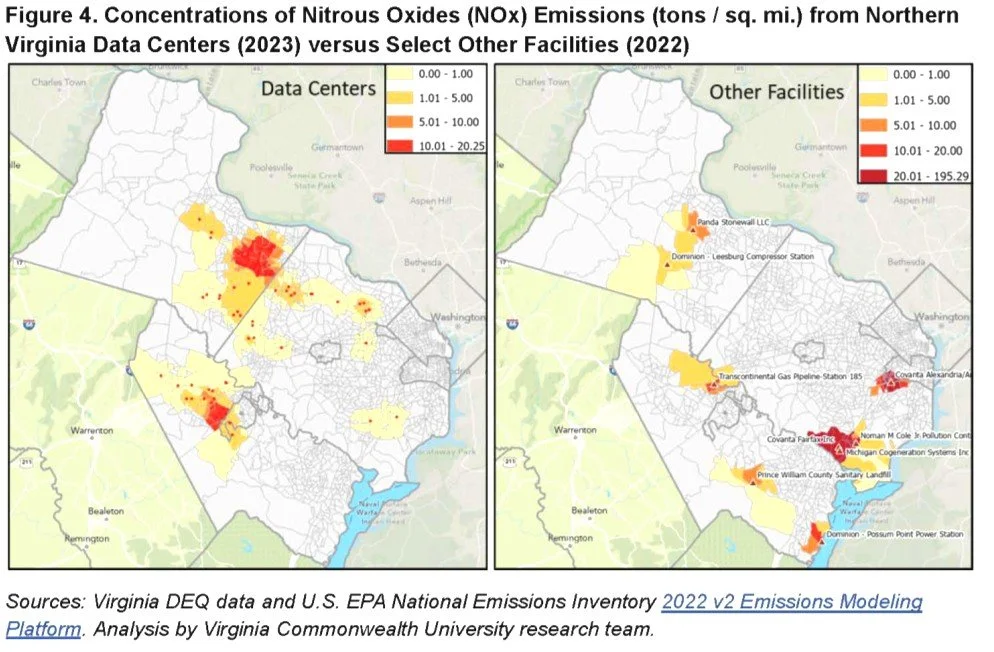
The researchers examined emissions from multiple data centers clustered within the U.S. Census Bureau block groups shown in the Figure 4, below from the 2026 study. The researchers commented:
“Perhaps more notably, the combined local emissions exposure from clusters of data centers can sometimes even exceed the pollution exposure associated with a natural gas power plant
Some block groups receive much more NOx exposure from data centers, compared to the highest block group NOx exposures from Dominion - Possum Point.”
The researchers found significant correlations pointing to:
inequitable environmental impacts from data center emissions, across various demographic categories.”
For example:
“Census block groups with higher estimated (2023) concentrations of CO and NOx from data centers tend to have lower household income levels, fewer residents with college degrees, and fewer owner-occupied housing units…”
The map on the left side of Figure 4, above shows nitrous oxides (NOx) emissions, in tons per year, from Northern Virginia data centers by census block group. Each of the red dots in Figure 4 left is an individual data center. Emissions are highest (10.01 – 20.25 tons per year) where multiple data centers are located within the same or adjacent block groups. However, a single data center can elevate NOx throughout a block group covering a relatively large area. For example, the northernmost data center in Figure 4, is located in a block group where NOx emissions are 1.01 –5.00 tons per year. The data center is about 1.5 miles from the perimeter of this block group.
Onsite Electricity Generation & Battery Storage: Resolving Air Pollution, Transmission Line & Coal-Fired Power Plant Impacts
Due to the large amount of electricity used, data centers can accelerate the release of air pollution, including climate-changing greenhouse gases, at distant power plants. Several states and local governments are moving towards onsite data center power generation and battery storage. There are several green generating options that release very little pollution.
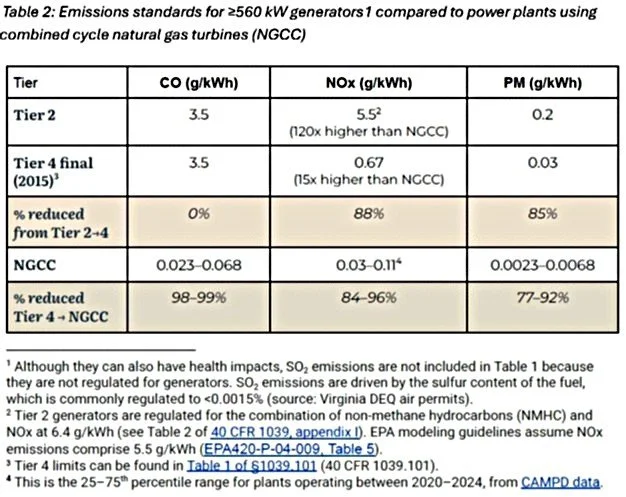
A better emerging data center air quality and human health solution is reliance on cleaner sources of backup emergency power such as combined cycle natural gas turbines with Selective Catalytic Reduction (SCR) emission controls as well as Battery Energy Storage Systems and renewables. Table 2, below, which was prepared by the Better Data Center Project, shows that while Tier-4 compliant generators release far less particulates and nitrogen oxides than Tier-2 models, reliance on combined cycle natural gas turbines as a backup power source along with Tier-4 compliant generators slashes both air pollutants to a far greater and healthful degree.
Residential Setbacks & Height Limits
Many ordinances require that data center buildings be located a minimum of 200 feet from residential property lines. Some require up to a 1,000-foot setback from homes.
Data centers are increasing in height. Most jurisdictions restrict data center building height to 40 feet and others allow buildings as high as 120 feet. As building height increases so does visual and noise impacts from rooftop equipment. One local jurisdiction requires a 200-foot setback from residentia property lines for data center buildings up to 60 feet in height and a 500-foot setback for those 60- to 80-feet high.
Visual Buffering
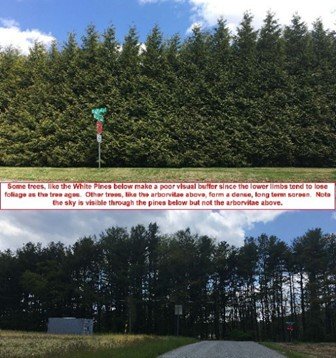
The area between a data center building and homes should be planted with trees and other vegetation to completely screen the building, substation, equipment-mechanical yard, parking lot, and all other visually objectionable structures from the view of area residents.
The trees should include at least a dense double row of evergreens that retain foliage year round from ground to tree top otherwise you may end up with a poor visual buffer like that shown in the lower photo on the left. Trees must attain a height sufficient to prevent visual impacts. In some cases it may be necessary to plants trees atop earth berms.

• Infrastructure requirements: Data center projects must include investments that benefit the broader community such as electric grid improvements, improved water systems, fiber connectivity-designed with excess capacity for future regional needs.
• Environmental standards: Mandatory water conservation, energy efficiency, and renewable energy commitments with regular reporting and verification.
• Economic commitments: Local hiring preferences, workforce development partnerships, and living wage standards for operations and construction.
• Community investment: Binding agreements allocating portions of tax revenue or requiring direct investments in schools, healthcare, workforce programs, or infrastructure.
• Transparency obligations: Regular public reporting on power usage, water consumption, employment, tax contributions, and community impacts.
• Approval processes: Comprehensive review that includes community input, environmental assessment, and infrastructure planning before approvals are granted.
Since the promise of good jobs, substantial tax revenues, and other benefits can make data centers seem attractive, verifying that these benefits are real and will actually be realized is vitally important. The verification should be done by an independent body. Following is a link to an example of such a independent review performed by Good Jobs First and Policy Matters Ohio: https://app.box.com/s/b5chzrvpqntr5nuiv116qju462rkzk3e.
Prepared by Richard Klein Community & Environmental Defense Services
410-654-3021 Rklein@ceds.org
February 19, 2026
There are a number of other options for reducing the visual impact of a building like stair-stepping floors with plantings on the roof of each lower level as shown in the illustration to the right. As stated above, earth berms or other measures should be considered if trees and other vegetation alone cannot completely block the view of a data center building from the view of area residents. By the way, trees and other vegetation are not very effective at blocking data center noise.
Traffic
Once completed, a data center generates relatively little traffic. Each building may only have 50 to 100 people inside at any given time which is why the long-term employment benefits of data centers are minimal.
The exception to this generalization may occur if backup diesel generators run for extended periods. Such an exception can occur when the primary electricity source is insufficient as illustrated in the July 2025 Loudoun County, Virginia heat wave example above. Extended generator operation can necessitate frequent tanker-truck traffic to refill diesel tanks. A single data center building may have 28 generators. If each generator fuel tank must be refilled every 3- to 5 days, then the tanker truck traffic could be considerable.
Very substantial traffic impacts can result during the 6- to 24-months required to construct a data center building. The route used by dump trucks and other heavy, noisy, exhaust emitting construction vehicles should not be within 500 feet of residential areas. Visual and noise impact prevention measures such as sound barrier walls, earth berms, and landscaping should be located within the minimum 500-foot buffer area.
Light Trespass & Glare
To prevent data center lights from shining into homes or ruining night sky views, all exterior lighting must be well-shielded and pointed downward. For specifics see the DarkSky Responsible outdoor lighting webpage at: https://darksky.org/resources/what-is-light-pollution/light-pollution-solutions/lighting/.
Ensuring Data Center Economic Benefits Are Delivered
Jobs and tax revenue are the principal economic benefits potentially offered by data centers, though not always delivered.
While there can be a large number of jobs during the 6- to 24-month construction phase, post-construction data center jobs are mostly low-paying security and maintenance positions. The high-paying jobs tend not to go to local residents unless required.
Tax revenue can be substantial provided state, or local officials do not waive taxes to attract a data center. As explained in the July, 2025, report What Happens When Data Centers Come To Town?, in some cases data centers have actually reduced tax revenue.
However, there are examples from across the U.S. where local and state officials locked data center owners-operators into agreements providing very substantial economic benefits to hosting communities. The October, 2025, article Beyond the Tax Check: How Data Centers Can Actually Benefit Communities, listed the following requisites for ensuring data center economic benefits are both substantial and actually delivered: