

Cui Bono: the Rise of the Data Center Industrial Complex*
By Matthew Shaw, Volunteer with the Coalition for Responsible Data Center Development
April 17, 2026
1: a principle that probable responsibility for an act or event lies with one having something to gain
-Merriam Webster
In previous articles, I have spoken of who does not benefit from Data Centers. This article will focus on who, for better or worse, does benefit from them and has incentives to keep building and using them for their own advantage. It is possible that some people will use them for, say, curing cancer; however, there are many other end users, investors, and powers that be who will reinforce their status quo with the help of Data Centers and the Artificial Intelligence they enable. This is not meant to be a comprehensive list, but to illustrate how many interests there are pushing for the development of more and larger Data Centers.
The Magnificent Seven
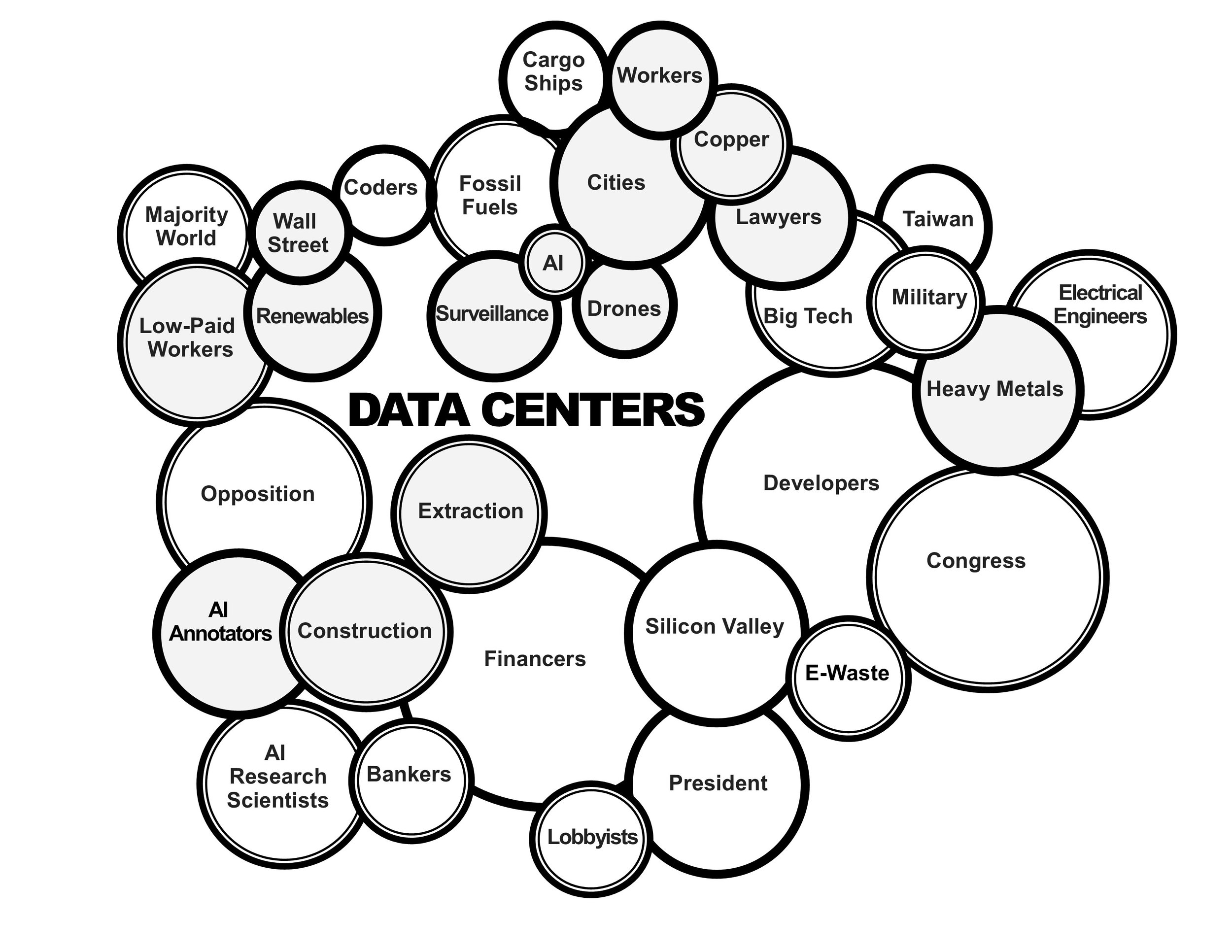
These are the most obvious beneficiaries of Data Center development, given their financial incentives to use and sell the use of Data Centers. The Magnificent Seven (Alphabet, Amazon, Apple, Tesla, Meta, Microsoft, and Nvidia) combined have a market capitalization of over $21 trillion, relying on Data Centers to sustain their growth and profits from research to manufacturing, development to rent seeking, and as end users of their own product. Apart from the large firms, there are numerous other companies, big and small, new and old, that stand to directly benefit from the Magnificent 7’s Data Centers. These include, but are not limited to, the following types of firms: construction, data center leasing, analytics, consulting, diesel generator, electricity generation and storage, cloud warehouse, HVAC and water cooling, fiber optics, IoT, and, of course, advanced chip manufacturing. These firms are like remora, the small suckerfish that cling to sharks, “removing ectoparasites and loose flakes of skin,” gaining nutrition and benefiting from their protection.
Financial Industry
The benefits of Data Centers to International Financial Institutions run across several axis including but not limited to: gains from investments in stocks, financing data centers directly, and using data centers for trading. The Magnificent 7 have dominated the main stock market indices, gaining approximately 36% of the S&P 500's market capitalization in late 2025, and in 2024, accounted for 59.6% of its price gain. Who has benefited from this increase? Looking at the ownership of these firms, Vanguard and BlackRock have large holdings, for example, in Apple, owning over 2.4 billion shares, equivalent to around 16% of all shares in the company.
The massive buildout of Data Centers by Alphabet, Microsoft, Meta, and Amazon alone is around $700 Billion in 2026, partially bankrolled by the companies themselves but also with the financial support of banks and private equity, such as Blue Owl, Blackrock, Apollo, Brookfield, to name but a few. Finally, Wall Street depends on data centers for analytics, prediction, and its high-frequency trading, allowing financial institutions to trade milliseconds faster than other firms without high-tech trading platforms. This technology may make some people very rich, but it also causes a host of issues, such as flash crashes, liquidity mirages, and increased systemic risks.
Military Industrial Complex
The recent strikes on an Amazon Data Center by Iran provide a glimpse into the Military’s increasing reliance on Data Centers to provide a military edge to the US’s war machine. While it is not known if those particular Data Centers were supporting the U.S. military, Amazon, Microsoft, Google, Oracle, and others are proud to provide Data Center services such as the Joint Warfighter Cloud Capability and specialized air-gapped networks. This means that for communities across America and around the world that host Data Centers, they may be seen as legitimate military targets in hostilities against the U.S. Additionally, for the U.S. military, it means that Data Centers have become increasingly important for their intelligence, reconnaissance, and operations in the field, binding them at the hip to Big Tech.
Fossil Fuel Industry
Data Centers require large quantities of fossil fuels to operate from the grid, on-site facilities, and backup diesel generators. This has led to over a dozen coal plants, which were scheduled for demolition, having those plans scrapped and continuing to operate, polluting our communities and environment. The so-called “behind-the-meter” approach to Data Centers’ energy supply often uses natural gas, with “natural gas consumption by data centers [expected to] rise by almost three times,” by 2030. Data center operators want to make sure that if their grid and/or behind-the-meter options fail, they have a backup option, which is typically diesel generators, “one of the dirtiest forms of generation we know,” leading to the release of nitrogen oxides, acid rain, and other harmful pollutants.
Extractive Industry
Besides fossil fuel extraction, there are a myriad of other materials needed for the construction and operation of data centers. You can find lists of them from the WEF and USGS, so I won’t list them all out, but they require labor, land, and energy for extracting, refining, manufacturing, and transporting all across the world. Mineral extraction often is owned by Western companies but involves exploitative conditions in the Majority World, with low pay and high health consequences. The land needed for extraction often comes from indigenous peoples’ territory, leading to environmental degradation and pollution, continuing the legacy of colonialism. Finally, the e-waste from Data Centers is estimated to be “5 million tonnes… per year,” which either ends up in landfills or is recycled, causing negative health effects, especially amongst pregnant women and children
Surveillance Industry
The recent fallout between Anthropic and the Department of War provides a glimpse into how the U.S. government wants to use Data Centers, and the AI they enable, to surveil American citizens. This is not restricted to DoW, with the NSA, DHS, and many other agencies hopping on the surveillance bandwagon. It is also not restricted to the U.S., with China using “social media monitoring, cameras, and facial recognition” to track and arrest dissident actions across its society.
“In ‘1984,’ there weren't enough people to watch all the surveillance cameras all of the time. But artificial intelligence can watch all of the surveillance cameras all of the time.”
Lawyers, Politicians, and Lobbyists
There are many other industries with ties and interests in Data Centers. Lawyers collect fees from lawsuits and help draft legislation impacting Data Centers. Politicians are drawn to support development by promises of increased tax revenues and campaign contributions. Lobbyists are being hired to swarm Washington, D.C., and state capitals on behalf of their corporate backers. AI companies are funding Super PACs to the tune of $125 million in 2025 alone to influence voters and politicians alike. This will make regulating their negative impacts more difficult by swaying public opinion and defeating politicians who want to help their communities.
Conclusion
The cloud is often thought of as a diaphanous construct, floating in the ether, ungrounded to anything material. The reality couldn’t be farther from the truth. Data Centers are the physical manifestations of the big data and AI industries, with their roots deeply embedded in the most powerful industries on our planet. The next time a Data Center wants to move into your community, you need to think of the material, labor, and environmental costs to develop, operate, and end it; the end users of the project and any negative actions they may wish to use it for; and the real threats to your community which having a Data Center brings from the health and environmental destruction to the threat of being targeted in a war.
There needs to be serious discussions of who benefits and who stands to be negatively affected by Data Centers. By mapping the interconnected nature of Data Centers with other industries, I hope to help communities weigh the costs associated with development beyond the carrots of a few jobs and the hope of some tax dollars.
* Note, when I came up with the idea for the Data Center Industrial Complex, I had hoped to be the first to do so, but of course, I was not. See Mél Hogan’s excellent paper here: https://scholar.google.com/citations?view_op=view_citation&hl=en&user=o2KMXskAAAAJ&citat ion_for_view=o2KMXskAAAAJ:1DsIQWDZLl8C
Sources:
Arcelia Martin, “Data Centers’ Use of Diesel Generators for Backup Power Is Commonplace—and Problematic,” Inside Climate News, November 12, 2025, https://insideclimatenews.org/news/12112025/data-center-diesel-generators-noise-pollution
Carolyn Neugarten, “Data Centers Are Fueling the Lobbying Industry, Not Just the Growth Of AI” MSN, https://www.msn.com/en-us/money/markets/data-centers-are-fueling-the-lobbying-industry-not-just-the-growth-of-ai/ar-AA1Q0JZ1#image=1
Clara Yalmanian, “The Dark Side of High-Frequency Trading: Examining Its Effects on Market Stability and Fairness,” Medium, June 18, 2024, https://wire.insiderfinance.io/the-dark-side-of-high-frequency-trading-examining-its-effects-on-market-stability-and-fairness-a05788bb5325
Darrell M. West, “How AI can enable public surveillance,” Brookings, April 15, 2025, https://www.brookings.edu/articles/how-ai-can-enable-public-surveillance/
Drew Robb, “Data Centers Bypassing the Grid to Obtain the Power They Need,” Data Center Knowledge, May 1, 2025, https://www.datacenterknowledge.com/energy-power-supply/data-centers-bypassing-the-grid-to-obtain-the-power-they-need
Ellen Thomas, “In the biggest market for data centers, Big Tech flashes cash and influence,” Business Insider, February 21, 2025, https://www.businessinsider.com/data-centers-political-power-big-tech-backing-2025-2?op=1
Emily Wilkins, “AI industry super PAC raises $125 million in 2025,” CNBC, January 30, 2026, https://www.cnbc.com/2026/01/30/ai-industry-super-pac-raises-campaign-money.html
F6S, “100 top Data Center companies and startups in United States in January 2026” January 1, 2026, https://www.f6s.com/companies/data-center/mo
Fintel, “Vanguard Group Inc ownership in AAPL / Apple Inc.” Accessed March 24, 2026, https://fintel.io/so/us/aapl/vanguard-group
First Trust, “S&P 500’s impressive first half dominated by the ‘Magnificent Seven’,” July 17, 2024,https://proactiveadvisormagazine.com/sp-500s-impressive-first-half-dominated-by-the-magnificent-seven/
Gaurav Roy, “Magnificent 7 Stocks and How They Move the S&P 500,” Securities.io, https://www.securities.io/magnificent-7-stocks-explained/
Geoff Brumfiel, “How AI is revolutionizing how governments conduct surveillance,” NPR, June 13, 2023, https://www.npr.org/2023/06/13/1181868277/how-ai-is-revolutionizing-how-governments-conduct-surveillance
Hugh Langley, “How Big Tech data centers became a military target during the war in Iran,” Business Insider, Mar 6, 2026, https://www.businessinsider.com/data-centers-iran-strikes-uae-bahrain-tech-military-target-war-2026-3?op=1
IEEE Xplorer, Pawan Whig, Et al. “Leveraging Reinforcement Learning and AlphaGo Algorithms for Enhanced Cancer Detection: A Novel Approach in Medical AI,” June 9, 2025, https://ieeexplore.ieee.org/abstract/document/11020462
Investopedia, Cedric Thompson “Magnificent 7 Stocks: What You Need To Know,” December 12, 2025, https://www.investopedia.com/magnificent-seven-stocks-8402262
Jennifer Elias, Tech AI spending may approach $700 billion this year, but the blow to cash raises red flags,” CNBC, February 6 2026, https://www.cnbc.com/2026/02/06/google-microsoft-meta-amazon-ai-cash.html
Karyn Pomerantz, “The Dark Side of AI: Labor, Inequality, and Environment,” The Multiracial Unity Blog, April 14 2025, https://multiracialunity.org/2025/04/14/the-dark-side-of-ai-labor-inequality-and-environment/
Kayla Matthews, “How Data Centers Power Wall Street and the Financial Sector,” Data Center Frontier, November 21, 2018, https://www.datacenterfrontier.com/colocation/article/11429902/how-data-centers-power-wall-street-and-the-financial-sector
Keith Speights, “This Company Owns a Big Chunk of the "Magnificent Seven" -- and Wall Street Thinks Its Stock Is a Screaming Buy,” Motley Fool, February 10, 2025, https://www.fool.com/investing/2025/02/10/this-company-owns-a-big-chunk-of-the-magnificent-s/
Kiva Allgood, Igor Hulak, “Metals at scale for AI at scale: securing the data centre materials backbone,” World Economic Forum, December 10, 2025, https://www.weforum.org/stories/2025/12/securing-data-centre-materials/
James Muldoon, Ana Valdivia, Adam Badger, “The politics of artificial intelligence supply chains,” AI & Society, September 18, 2025, https://link.springer.com/article/10.1007/s00146-025-02625-y
Jeffrey Caleb Hendrix, “Data Centers: The Legal and Legislative Landscape,” University of South Carolina, https://sc.edu/study/colleges_schools/law/centers/techinlaw/_blog_articles/data-centers-legal-legislative-landscape.pdf
Joe Fassler, “These 15 Coal Plants Would Have Retired. Then Came AI and Trump.” Desmog, December 15 2025, https://www.desmog.com/2025/12/12/15-coal-plant-retirements-delayed-ai-data-centers-trump-doe-orders/
Merriam Webster, “Cui Bono,” Accessed January 23, 2026, https://www.merriam-webster.com/dictionary/cui%20bono
Nathaniel Stone, “Wall Street's Quiet AI Infrastructure Boom: How Private Credit and Data Center Expansion Are Unlocking a $150 Billion Opportunity for Institutional Investors,” AInvest, August 13, 2025, https://www.ainvest.com/news/wall-street-quiet-ai-infrastructure-boom-private-credit-data-center
-expansion-unlocking-150-billion-opportunity-institutional-investors-2508/
Sam Biddle, “Data Centers are Military Targets Now,” The Intercept, March 2, 2026, https://theintercept.com/2026/03/20/ai-data-centers-military-targets-iran-war/
USGS, “Key Minerals in Data Centers Infographic,” July 2025, https://www.usgs.gov/media/images/key-minerals-data-centers-infographic
Vidhi Taparia, “Explained: Why is the Pentagon locked in a dispute with Anthropic?” ETTech, February 16, 2026, https://economictimes.indiatimes.com/tech/artificial-intelligence/explained-why-is-the-pentagon-locked-in-a-dispute-with-anthropic/articleshow/128427478.cms
Wikipedia, “Remora,” https://en.wikipedia.org/wiki/Remora
World Health Organization, “Electronic waste (e-waste),” October 1, 2024, https://www.who.int/news-room/fact-sheets/detail/electronic-waste-%28e-waste%29