

Data Centers, the Doomsday Clock, and the Sixth Mass Extinction Event
By Matthew Shaw, Volunteer with the Coalition for Responsible Data Center Development
February 15, 2026
Introduction
Scientists have been sounding the alarm on a series of secular apocalypses for the past 79 years with the birth of the Doomsday Clock. Other (or more likely, an overlapping group of) scientists have been sounding the alarm over the Sixth Mass Extinction event in our planet's history. But what do these messianic visions have to do with that ethereal notion of the cloud?
The Doomsday Clock was founded by the Union of Concerned Scientists, which itself was founded “in 1945 by Albert Einstein, J. Robert Oppenheimer, and University of Chicago scientists who helped develop the first atomic weapons in the Manhattan Project.” The clock is a metaphor for humankind’s ability to destroy itself, originally by means of nuclear Armageddon, and now by what critics have called a “grab bag of threats.” In 2025, these threats fell into the following categories: Nuclear Risk, Climate Change, Biological Threats, and Disruptive Technologies. In the following article, I will endeavor to explain how Data Centers fit into this grab bag, not only enabling the disruptive technologies, but also catalyzing the other three threats both directly and indirectly.
Before I do so, let me explain the second jargony term, the so-called “Sixth Mass Extinction” event. The general public will likely be familiar with the last mass extinction event, the “Cretaceous-Paleogene extinction,” widely credited to an enormous meteor slamming into our little blue planet, which led to the end of the dinosaurs and the rule of the mammals. The 4 previous mass extinction events were likely due to other natural sources, such as (in layman’s terms): too much oxygen, not enough oxygen, too much heat, not enough sunlight, and enormous volcanic eruptions. The World Wildlife Fund points to the following causes of our sixth mass extinction: “the unsustainable use of land, water, and energy, and climate change.” The mass extinction of life on our planet, caused by human activity, poses two key issues in my view: it may lead to the extinction of humanity, and it is immoral in its own right to genocide from our world other forms of life.
Data Center and the Nuclear Threat
The Doomsday Clock authors have long argued that nuclear weapons are a primary threat to human survival. This has become a trope in pop culture, from Dr. Strangelove to Fallout; we have been living with the risk so long that many take for granted that we are all on the precipice of a nuclear holocaust. I believe Data Centers pose the following risks in escalating this risk: AI in command and control, increased proliferation of nuclear materials for energy, and increased knowledge for building weapons systems.
Command and control are defined by the Department of War (DoW [formerly the Department of Defense]) as “[t]he exercise of authority and direction by [a] properly designated commander over assigned forces in the accomplishment of the mission.” To oversimplify the term in plain English, when it comes to nuclear weapons, who has the authority and ability to launch humanity-ending weapons? The DoW is actively researching how to integrate AI systems to make decisions in a matter of seconds, using “the cloud” in numerous levels of decision-making from surveillance to targeting decisions. There are many known problems with AI, such as its consistent hallucinations, which the former Chief Technology Officer of the CIA has referred to as a “crazy, drunk friend.” Even if we use human-in-the-loop systems, if data centers are providing faulty data, humans may not have the time to find out until it is too late.
Data Centers require enormous quantities of energy to operate, consuming 4.4 % of the total energy consumption in the U.S. in 2023 and are predicted to use up to 12% by 2028. Nuclear power offers many advantages for Data Centers: providing 24/7 power, few shutdowns, and steady prices, to name a few. However, the increasing construction of nuclear reactors poses the risk that “facilities constructed for use in a nuclear energy program could eventually be used to produce nuclear weapons.”
Nuclear power plants take a long time to build but are expected to become an increasing mix of energy consumption in the U.S. and China, according to data from the International Energy Agency (IEA).
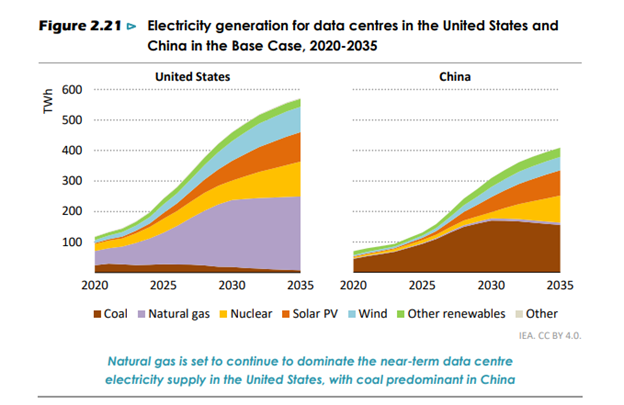
(Source: IEA, page 88)
Nuclear physics and rocket science are colloquially thought to be the peak of scientific and human intelligence, but what happens when Data Centers can provide the generative AI to put together nuclear weapons and the ability to deliver them? As Allison and Herzog point out “[i]n worst‐case scenarios, frontier systems may rival entire weapon design teams within just a few years, especially in compressing tacit knowledge.” Data Center and AI companies may counter that they are actively developing guardrails; however, as Chinese hackers were able to demonstrate with Anthropic’s Claude, even the most rigorous prevention mechanisms can be wiggled around for nefarious purposes.
Data Centers and Climate Change
The climate, as defined by Britannica, is the “conditions of the atmosphere at a particular location over a long period of time; it is the long-term summation of the atmospheric elements (and their variations) that, over short time periods, constitute weather. These elements are solar radiation, temperature, humidity, precipitation (type, frequency, and amount), atmospheric pressure, and wind (speed and direction).” For the purposes of this paper, I am going to focus on the changes in temperature and sea level as noted by the EPA.
As noted in the nuclear energy section, Data Centers require enormous amounts of energy to run and cool their chips. According to the Union of Concerned Scientists, Figure 2 shows that in 2023, Data Centers used fossil fuels, including coal and gas, for approximately half of their energy needs. These come from both the electric grid demand and the backup diesel generators that Data Centers use before connecting to the grid and in the event of blackouts. These fossil fuels release carbon dioxide, nitrous oxide, and methane, all of which act as greenhouse gases, trapping the sun’s heat in our atmosphere.
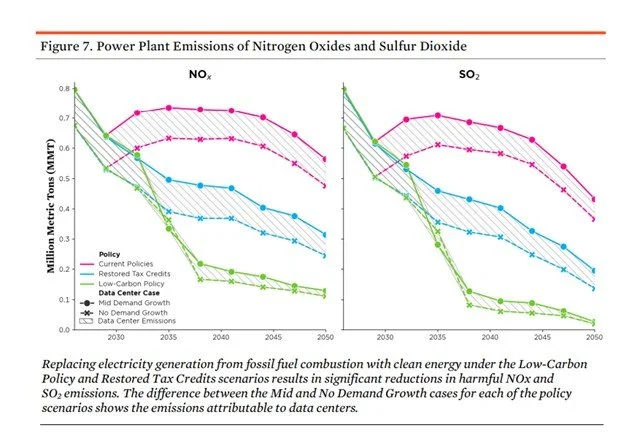
(Source: Union of Concerned Scientists, page 17)
Sea level rise is often thought of as being the result of glacier and polar cap melt. This is true, but it is not the full picture. According to a paper in Science Advances, groundwater depletion “rivals GIC [i.e., glaciated] contributions.” Data Centers contribute to this through their use of water in many cooling systems, using an estimated 1.8 billion gallons annually.Compared to agriculture, which consumes 2 quadrillion gallons of water annually, this is a drop in the bucket (pun intended). However: 1) Data Center water consumption is typically only measured in direct usage, not indirectly from power generation; 2) US Data Center electricity demand (and presumably water consumption will follow this trend unless less consumptive techniques are used) is expected to grow 400% by 2030, and 3) unrelated to sea level rise, Data Center water consumption is centralized, often affecting already water-stressed communities.
Data Centers and Biological Threats
The 2026 doomsday clock release on the biosecurity outlook includes AI tools as one of the four main concerns related to biological threats. The two threats they highlight are the development of new proteins and genome language models, which “can design novel functional viruses.” I would add that two of their other threats, biological weapons programs and “mirror life” synthetic lifeforms can also be accelerated by the use of data centers in developing novel threats to humankind. There has been significant research focused on AI and bioweapons, such as that by the Center for a New American Security and RAND. While in my research, there is less reporting and research on AI and mirror life, the main limitation appears to be technical, which AI will certainly play a role in overcoming.
For additional information regarding the biological risks from AI I suggest reviewing the International AI Safety Report. For example, their graphic showing how “AI tools could assist at multiple stages of biological weapons development”:
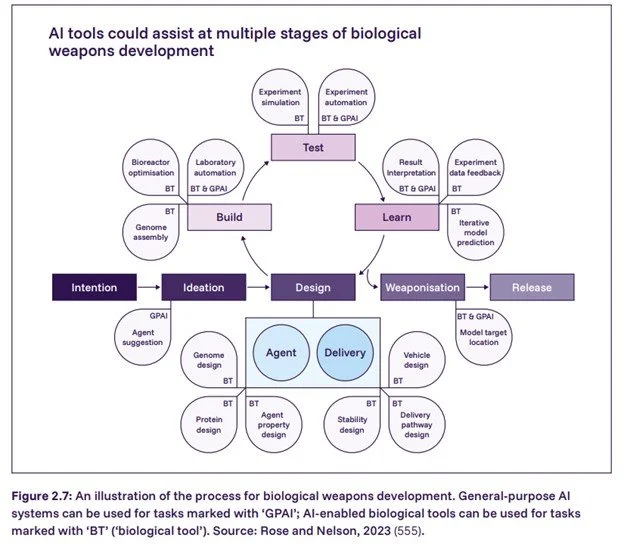
(Source: International AI Safety Report 2026, Page 66)
Data Centers and Disruptive Technologies
Data Centers enable AI, which creates the potential to accelerate the threats to humanity, including but not limited to: nuclear strikes (which I have already gone into), information corruption (through mis- and disinformation campaigns [for example, deep fakes]), the militarization of space, and chemical agents. Another worrying sign for humanity is generative AI’s ability to lie, deceive, and even sabotage commands and blackmail coders to avoid being turned off. If Artificial General Intelligence (AGI) is really only 1-2 years away, and AGI has its best interests at heart instead of humanity’s, there is no telling what threats it will come up with, as it will not tell us what it has in store for us. A true unknown unknown.
For an example of how AI has led to harms such as injury, disruption of critical infrastructure, violations of human rights, and harm to property, communities or the environment, see: AIM: AI Incidents and Hazards Monitor produced by the Organisation for Economic Co-operation and Development (OECD).
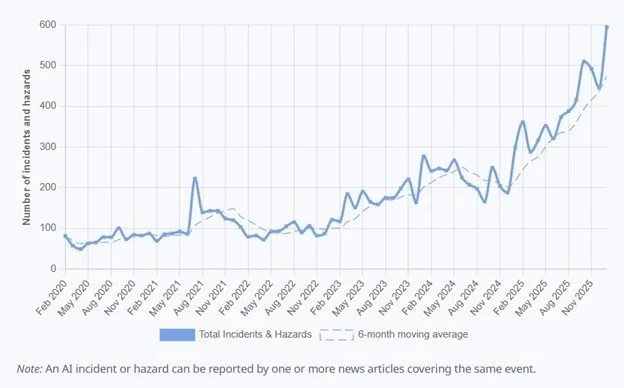
(Source: AIM: AI Incidents and Hazards Monitor, Accessed February 4, 2026)
Data Centers and the Sixth Mass Extinction
The Center for Biological Diversity provides six ways Data Centers are impacting the biosphere: supercharging the climate crisis, reducing fresh water sources, water pollution, air pollution, noise disruption, and the fragmentation of habitats by construction and development. These impacts contribute to biodiversity loss by directly reducing the livable space animals have, cutting off key migratory routes, spoiling the land, air, and water, and degrading habitat value, leading to disruptions in feeding, reproduction, and pollination. Humans rely on plants and animals for food, medicine, and to pollinate our agriculture. We are shooting ourselves in the foot by destroying the ecosystems that keep our civilizations flourishing.
The Earth has not seen anything as destructive to the biosphere since the meteor that took out the dinosaurs, with extinction rates “100 to 1000 times higher than the background extinction rate”. As I have argued throughout this paper, Data Centers are accelerating ‘the unsustainable use of land, water, and energy, and climate change’ which is driving the Holocene extinction event. There are many reasons why this is bad for humans, such as ecosystem instability, reduced ecosystem services, threats to human health, and economic impacts. For Data Centers to limit their impact, they must therefore become smaller, more energy and water-efficient, and have controls over what the AI they are running is able to do.
“There’s a high environmental cost to the data center boom, particularly for communities and wildlife whose homes are being overrun by noisy, water-guzzling, energy-intensive data centers,” said Aruna Prabhala, Urban Wildlands Program Director for the Center for Biological Diversity. “At the very least, local officials should fully embrace ways to reduce environmental harms when considering these projects that pollute communities or degrade wildlife habitat.”
Conclusion
What is humankind to do with this knowledge? Should governments write laws that may limit economic innovation or cause the worst actors to go underground? Should we let AI companies self-regulate, or is this exactly what bad actors are pushing for, as Dario Amodei (CEO of Anthropic) argues, “the least responsible players… advocate most strongly against regulation.” Can we trust governments to regulate a technology when they receive hundreds of millions of dollars in campaign contributions and have millions more on lobbying efforts to capture the regulators?
I do not pretend to have all (if any) of the solutions to these issues. Some researchers have argued for a “layered governance” approach mixing government and NGO regulators with flexibility for companies. Some countries have tried to regulate AI platforms, such as South Korea and the EU, creating requirements for different levels of risk and capabilities. Others argue that “no national regulator” can control big tech firms, necessitating a global governance of platforms.
Whatever the solution, compromise, or lack of control, it will not just be a technical fix to a snippet of code but a political one. One that will be decided in smoke-filled corporate boardrooms, by techies working on their beds in their PJs, and in the streets by everyday people seeking a brighter tomorrow for their children.
Sources:
Amerlia Mink, “Big Tech Lobbies for a Seat at the Table as the 119th Congress Sets Its Tech Policy Priorities” Issue One, April 22, 2025 https://issueone.org/articles/big-tech-lobbies-for-a-seat-at-the-table/
Angela Yang, How far will AI go to defend its own survival?” NBC News, June 1, 2025, https://www.nbcnews.com/tech/tech-news/far-will-ai-go-defend-survival-rcna209609
Arman Shehabi, et al. “2024 United States Data Center Energy Usage Report” Lawrence Berkeley National Laboratory. December 2024 https://escholarship.org/uc/item/32d6m0d1
Aruna Prabhala, Email communication, February 13, 2026
Bill Drexel and Caleb Withers, “AI and the Evolution of Biological National Security Risks: Capabilities, Thresholds, and Interventions,” CNAS, August 13, 2024 https://www.cnas.org/publications/reports/ai-and-the-evolution-of-biological-national-security-risks
Britannica, Anna Dubey, “Major Mass Extinctions” Accessed January 27, 2026 https://www.britannica.com/list/major-mass-extinctions
Boston Institute of Analytics, “AI-Powered Cyberattack: Chinese Hackers Exploit Anthropic’s Claude Code for Mass Espionage,” November 25, 2025, https://bostoninstituteofanalytics.org/blog/ai-powered-cyberattack-chinese-hackers-exploit-anthropics-claude-code-for-mass-espionage/
Bulletin of the Atomic Scientists “The Doomsday Clock Through Time” Accessed January 27, 2026 https://thebulletin.org/doomsday-clock/timeline/
Bulletin of the Atomic Scientists “2025 Doomsday Clock Statement” Accessed January 27, 2026 https://thebulletin.org/doomsday-clock/2025-statement/
Bulletin of the Atomic Scientists, “In Depth: Disruptive Technologies,” January 27, 2026, https://thebulletin.org/doomsday-clock/2026-statement/disruptive-technologies/
Center for Arms Control and Non-Proliferation, “Nuclear Proliferation Risks in Nuclear Energy Programs,” Accessed January 27, 2026, https://armscontrolcenter.org/wp-content/uploads/2018/04/Nuclear-Proliferation-Risks-in-Nuclear-Energy-Programs.pdf
Center for Biological Diversity, “The Wildlife Costs of Data Centers,” Document provided by Aruna Prabhala, Accessed February 3, 2026
Christopher A. Mouton, Caleb Lucas, and Ella Guest, “The Operational Risks of AI in Large-Scale Biological Attacks: A Red-Team Approach,” RAND, 2023 https://www.rand.org/content/dam/rand/pubs/research_reports/RRA2900/RRA2977-1/RAND_RRA2977-1.pdf
Congressional Research Service, “Defense Primer: What is Command and Control?” November 29, 2021 https://www.congress.gov/crs_external_products/IF/PDF/IF11805/IF11805.2.pdf
Dario Amodei, The Adolescence of Technology,” January 2026, https://www.darioamodei.com/essay/the-adolescence-of-technology
David M. Allison and Stephen Herzon, “Artificial Intelligence and Nuclear Weapons Proliferation: The Technological Arms Race for (In)visbility” Risk Analysis, Volume 45, Issue 11, pp.3839-3859 https://onlinelibrary.wiley.com/doi/10.1111/risa.70105
Eric Olson, Anne Grau, and Taylor Tipton, “Data centers draining resources in water-stressed communities,” July 19, 2024, https://utulsa.edu/news/data-centers-draining-resources-in-water-stressed-communities/
European Parliament, “EU AI Act: first regulation on artificial intelligence” June 8, 2023, https://www.europarl.europa.eu/topics/en/article/20230601STO93804/eu-ai-act-first-regulation-on-artificial-intelligence
Gerardo Ceballos, et al. “Accelerated modern human-induced species losses: Entering the sixth mass extinction” Environmental Sciences, June 19, 2025 https://www.science.org/doi/10.1126/sciadv.1400253
High Tide Technologies, “Water Usage In The Agricultural Industry” Accessed January 28, 2026, https://www.htt.io/learning-center/water-usage-in-the-agricultural-industry
IEA, “Energy and AI,” April 2025, https://iea.blob.core.windows.net/assets/de9dea13-b07d-42c5-a398-d1b3ae17d866/EnergyandAI.pdf
James Murray, “Are we in the sixth extinction?” IERE, December 1, 2025 https://iere.org/are-we-in-the-sixth-extinction/
James S. Johnson, “Artificial Intelligence: A Threat to Strategic Stability” Strategic Studies Quarterly, Spring 2020 https://www.airuniversity.af.edu/Portals/10/SSQ/documents/Volume-14_Issue-1/Johnson.pdf
James Scouras, “Nuclear War as a Global Catastrophic Risk” 2020 https://www.jhuapl.edu/sites/default/files/2022-12/NuclearWarGlobalRisk.pdf
K. P. Adamala et al. “Confronting risks of mirror life” Science, 2024, 10.1126/science.ads9158, http://softbeam.net/research/wp-content/uploads/2024/12/Science-2024-Confronting-risk-of-mirror-life.pdf
Live Science, Tia Ghose, “Is the Doomsday Clock Still Relevant February 24, 2016 https://www.livescience.com/53801-doomsday-clock-relevance.html
Regulating Big Tech, “Luigi Zingales,” Bank of International Settlements, December 2022, https://www.bis.org/publ/work1063.pdf
Maria Jose Murcia and Roy Suddaby, “A layered governance approach to regulating Big Tech,” Long Range Planning, Volume 57, Issue 4, August 2024 https://www.sciencedirect.com/science/article/abs/pii/S0024630124000402
McKinsey & Company, “The data center balance: How US states can navigate the opportunities and challenges,” August 2025, https://www.mckinsey.com/industries/public-sector/our-insights/the-data-center-balance-how-us-states-can-navigate-the-opportunities-and-challenges
Michael J.D. Vermeer, “Could AI Really Kill Off Humans?” RAND, May 9, 2025 https://www.rand.org/pubs/commentary/2025/05/could-ai-really-kill-off-humans.html
Michelle Starr, “AI Has Already Become a Master of Lies and Deception, Scientists Warn,” Science Alert, May 11, 2024 https://www.sciencealert.com/ai-has-already-become-a-master-of-lies-and-deception-scientists-warn
Miguel Yañez-Barnuevo, “Data Center and Water Consumption,” Environmental and Energy Study Institute, June 25, 2025, https://www.eesi.org/articles/view/data-centers-and-water-consumption
OECD, “AIM: AI Incidents and Hazards Monitor,” Accessed February 4, 2026, https://oecd.ai/en/incidents?search_terms=%5B%5D&and_condition=false&from_date=2020-02-04&to_date=2026-02-04&properties_config=%7B%22principles%22:%5B%5D,%22industries%22:%5B%5D,%22harm_types%22:%5B%5D,%22harm_levels%22:%5B%5D,%22harmed_entities%22:%5B%5D,%22business_functions%22:%5B%5D,%22ai_tasks%22:%5B%5D,%22autonomy_levels%22:%5B%5D,%22languages%22:%5B%5D%7D&order_by=date&num_results=20
Office of Nuclear Energy, “Advantages and Challenges of Nuclear Powered Data Centers,” April 8, 2025, https://www.energy.gov/ne/articles/advantages-and-challenges-nuclear-powered-data-centers
Paul E. Waggoner, “Climate” Britannica, December 24, 2025 https://www.britannica.com/science/climate-meteorology
Raphael Hernandes, Lauren Aratani, and Will Craft, “Revealed: the tech bosses who poured #394.1m into US election - and how they compared to Elon Musk” The Guardian, December 7, 2024, https://www.theguardian.com/us-news/2024/dec/07/campaign-spending-crypto-tech-influence
Raphael Rashid, “South Korea’s ‘world-first’ AI laws face pushback amid bid to become leading tech power” The Guardian, January 28, 2026 https://www.theguardian.com/world/2026/jan/29/south-korea-world-first-ai-regulation-laws
Robert Fay, “A Model for Global Governance of Platforms” Regulating Big Tech: Policy Responses to Digital Dominance, October 2021, https://academic.oup.com/book/39213/chapter-abstract/338718174?redirectedFrom=fulltext
Southern Environmental Law Center, “Overhyped data center growth is shaping our energy future,” August 8, 2025https://www.selc.org/news/overhyped-data-center-growth-is-shaping-our-energy-future/
Steve Clemer et al. “Data Center Power Play” Union of Concerned Scientists, January 2026 https://www.ucs.org/sites/default/files/2026-01/Data-Center-Power-Play-report-final.pdf
UK Government, “International AI Safety Report: 2026,” February 2026, https://internationalaisafetyreport.org/sites/default/files/2026-02/international-ai-safety-report-2026.pdf
Vladislav Chernacskikh, SIPRI, “Nuclear Weapons and Artificial Intelligence: Technological Promises and Practical Realities,” September 2014 https://www.sipri.org/sites/default/files/2024-09/bp_2409_ai-nuclear.pdf
World Wildlife Fund, “What is the sixth mass extinction and what can we do about it?” https://www.worldwildlife.org/resources/explainers/what-is-the-sixth-mass-extinction-and-what-can-we-do-about-it/